
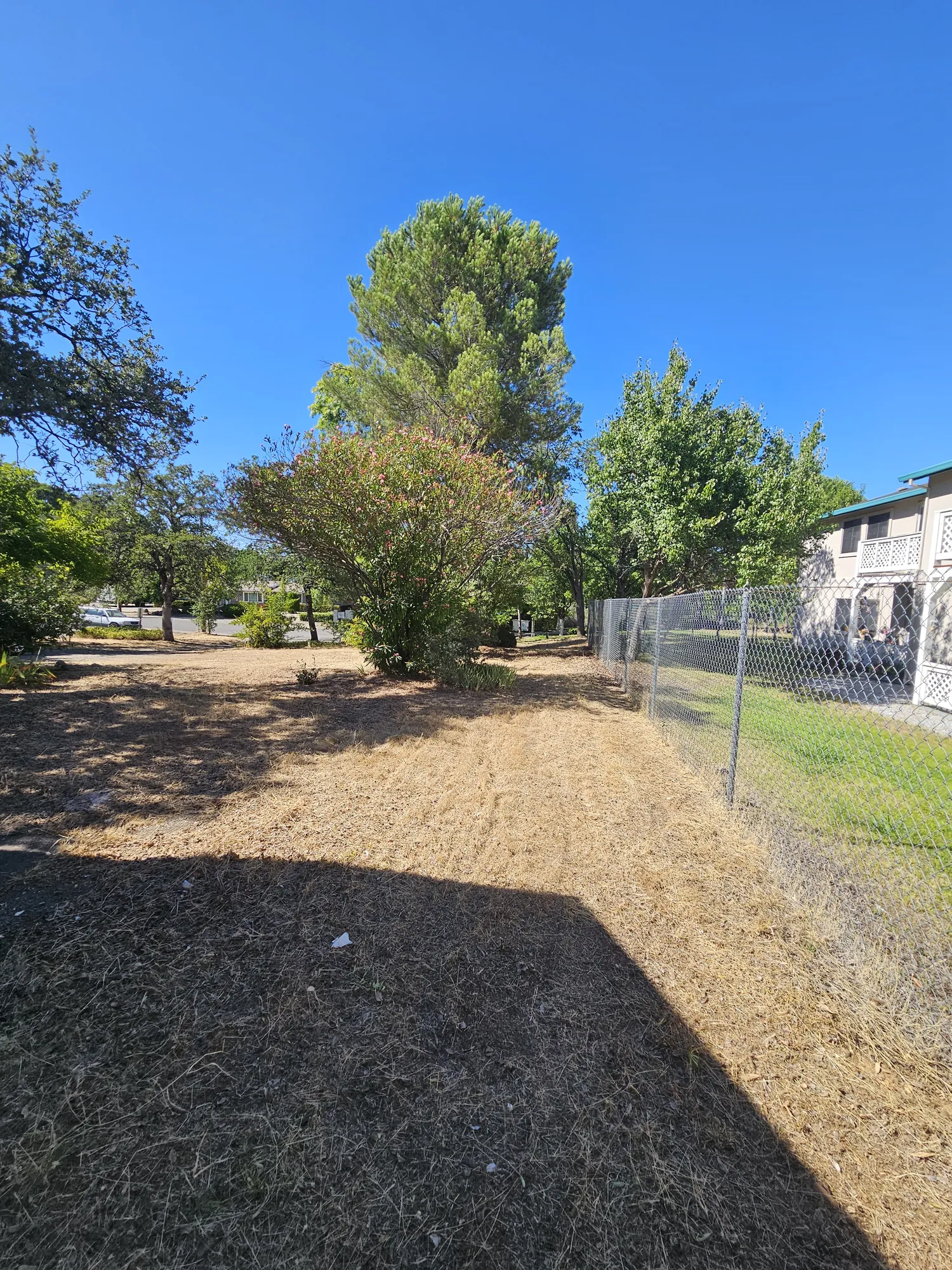
How do you clear an overgrown fence line on a ranch in Shasta County?
Cut both sides of the line to the ground by hand. Detail around every post and gate, then pull blackberry crowns while the soil is moist. Stage the material in piles or haul it, then put the line on a repeat cut. Fence work is priced by the linear foot, not by the acre.
Ranch lines here disappear the same way every time. The strip under the wire never gets mowed. Blackberry, cured grass, saplings and wild grape take it over. Opening it again is fence line and roadside clearing, and it is hand work end to end.
Why does a fence line grow over before the rest of the place?
Because nobody mows it, and a mower cannot reach the strip under the wire. Growth starts there and stays, and Himalayan blackberry then walks the line on its own. UC IPM reports that cane tips touching the ground often form roots, creating daughter plants. Over time a single plant can cover a very large area.
The canes live about two years, but the crown under them keeps going. That is why a line you cut once looks the same again a season later.
Cover also brings animals that make the fence worse. UC IPM says ground squirrels often dig their burrows along ditches and fencerows around buildings. Weeds and dense vegetative cover encourage voles. UC IPM suggests a buffer strip 4 feet or more wide, because voles prefer not to feed in the open.
| Growth | Problem it causes | Hand method | Season |
|---|---|---|---|
| Himalayan blackberry | Cane tips root into daughter plants, so the thicket walks the line (UC IPM 7434) | Canes cut to the ground with blade heads, crowns pulled in moist soil | Cut any time, pull early spring or late fall |
| Cured annual grass | Fuel loaded on the wire, and a fire path in a straight line | String heads on both sides, cuttings raked off the wire | Late spring as the grass cures |
| Saplings and woody growth | Wire pushed out of line, and a run nobody can walk | Cut flush at ground level with blade heads | Late fall to winter |
| Wild grape and other vines | Weight on the wire, and the fence buried out of sight | Cut at the base, pulled off the wire by hand | Late fall to winter |
Poison oak on the wire is its own job. How to get rid of poison oak plants covers what works on it.
What does an overgrown line actually cost you?
Four things, and tidiness is not one of them. The fence lasts less time, and a hot wire loses its charge. The line becomes a fire path aimed at your buildings. And a fence contractor bills you for the hours spent fighting growth.
University of Maine Extension says it plainly. Keep trees and weeds from growing up around the fence to increase its useful life. The same guidance says checking for problems is very important to reduce your chances of liability.
On an electric fence the loss is the shock itself. MSU Extension’s charger bulletin says older high impedance chargers are easily grounded out by vegetation until little to no shock value is left, and that lower wires carry a higher vegetative load for any charger to push through.
The fire case is the strongest one. NIST ran 187 experiments on fences and mulch and published the results in 2022. Its researchers call fences and mulch beds bridges for flames to reach buildings and launch pads for airborne embers. In the highest hazard category, fire moved toward the house in a matter of a few minutes, not hours.
How does a hand crew open a line that has vanished?
We cut both sides to the ground wherever access allows. String heads take the grass, and blade heads go through hefty brush about two fingers thick. Every post and gate gets detailed by hand. Material is raked into clean piles or loaded out by the trailer-load.
Blackberry goes by the calendar, not by force, and our guide on how to get rid of blackberry bushes compares every method side by side. UC IPM says plants come out easiest in early spring or late fall, when the soil is moist. Pulling in dry, hard soil breaks off the stems and leaves roots that will vigorously resprout. So crown work waits for wet ground, and the canes get cut whenever you need the line back.
Nothing about this holds forever. UC IPM says blackberries regenerate from the crown or rhizomes after mowing, pulling, burning or herbicide. Regrowth gets managed with scheduled cuts. Larger parcels usually end up on a standing vegetation and acreage management schedule.
Machines are a poor fit tight against wire, posts, rock and slopes. Hand crew versus machine brush clearing has the full comparison.
If the wire itself is finished, fence and post removal is its own service. Old wire has to come out of the growth first.
Which rules touch a fence line here?
Four, and only one of them is new. State law sets a 100-foot defensible space standard around buildings. Shasta County sets a grass height in the unincorporated county, and Zone 0 was adopted in August 2026. Roadside clearance is a county and agency matter, not a statewide rule.
| Rule | Where it applies | What it says |
|---|---|---|
| PRC 4291 (state law) | State Responsibility Area, around buildings | ”Maintain defensible space of 100 feet from each side and from the front and rear of the structure.” Fuel includes grasses, weeds and wildland vegetation |
| Shasta County Code Chapter 8.10 (adopted 9/23/2025) | Unincorporated Shasta County | Weeds and annual grasses kept to 4 inches or less. Parcels of 2 acres or less: the whole parcel. Parcels of 2 to 10 acres: a 30-foot cleared perimeter or an approved plan |
| Zone 0 (Board of Forestry, adopted 8/19/2026) | SRA and Very High Fire Hazard Severity Zones, once effective | Adopted, taking effect in phases. A fence or gate attached to a home needs a 5-foot noncombustible span. Grass in the zone mowed to 3 inches |
| Driveway and roadside clearance | County ordinances and agency access guidance | No statewide 10-foot rule covers existing driveways. Many counties require it and agencies ask for it |
Read PRC 4291 plainly and a fence line inside the 100 feet is inside the mandate. The statute defines fuel as combustible material including grasses, weeds and wildland vegetation. That is a plain reading, not an agency ruling on your parcel. Clearing to the standard is defensible space work.
Zone 0 is the one to watch. The Board of Forestry adopted it on August 19, 2026, and it is not in effect yet. A fence or gate attached to a home will need a 5-foot noncombustible span. What the new Zone 0 rules mean for your home has the phase-in dates.
Who pays when the line is shared?
Civil Code 841 is the statute behind the phrase Good Neighbor Fence Act. It says adjoining landowners shall share equally in the responsibility for maintaining the boundaries between them. For a dividing fence, both owners are presumed equally responsible for the reasonable costs of building, maintaining or replacing it.
The law also sets the order of operations. A landowner gives 30 days of written notice to each affected adjoining landowner before spending.
One caution. The statute is written about the fence itself, not about vegetation work. Do not assume a neighbor owes half of a clearing bill because the wire is shared.
The practical version is simpler. Talk to the neighbor first, then put one written estimate in front of both of you. The same crew cuts both sides in a single visit, which costs less than two trips. If the disagreement is real, that is a conversation for a property lawyer.
What does fence line clearing cost?
Nobody can price a line by the mile over the phone. Fence work is quoted by the linear foot, after someone walks the runs. Density, terrain and how many sides get cut all move the number. Published guides still give you a range to start from.
Ergeon’s 2026 fence cost guide prices it directly. Brush, vines and roots grown into a fence line add $2 to $5 per linear foot to clear.
Open ground gets priced by the acre instead. HomeGuide puts brush removal at about $800 to $3,000 per acre in 2026, with cleanup labor at $50 to $80 per hour.
Our number comes off the ground, not off a table. The written estimate names the runs in linear feet, the sides being cut, and the debris handling. We carry $1 million in general liability, and a certificate is available on request. Fence line and roadside work priced by the foot is the service page.
When should the line get cut?
Grass work lands in late spring, as the crop cures. Blackberry crowns pull after the first real rains, when the ground is soft. Redding takes 33.52 inches of rain in an average year, and about 67 percent falls December through March. The pulling season and the wet season are the same season.
July here averages 99.9 degrees and 0.07 inches of rain. Grass that was green in April is cured fuel by June. Cutting still happens through the heat, because a fuel line to your barn does not wait. The Redding-area clearing calendar covers the rest of the year.
Clear ahead of a fence contractor. Growth in the line is billable time for them.
Cut material is not burned this season. CAL FIRE burn permits in the Shasta County State Responsibility Area have been suspended since June 15, 2026. Everything we cut is staged in piles or hauled off.
We open fence lines and road edges on ranch ground around Cottonwood, Palo Cedro, Millville, Red Bluff and Corning. We are a veteran-owned company based in Redding.
Walk the runs with us and you get the footage in writing. The walk-through is usually within days, and both it and the written estimate are free. Call or text (530) 238-5077 anywhere within 50 miles of Redding.