
Hand crew or machine: which brush clearing method does your property need?
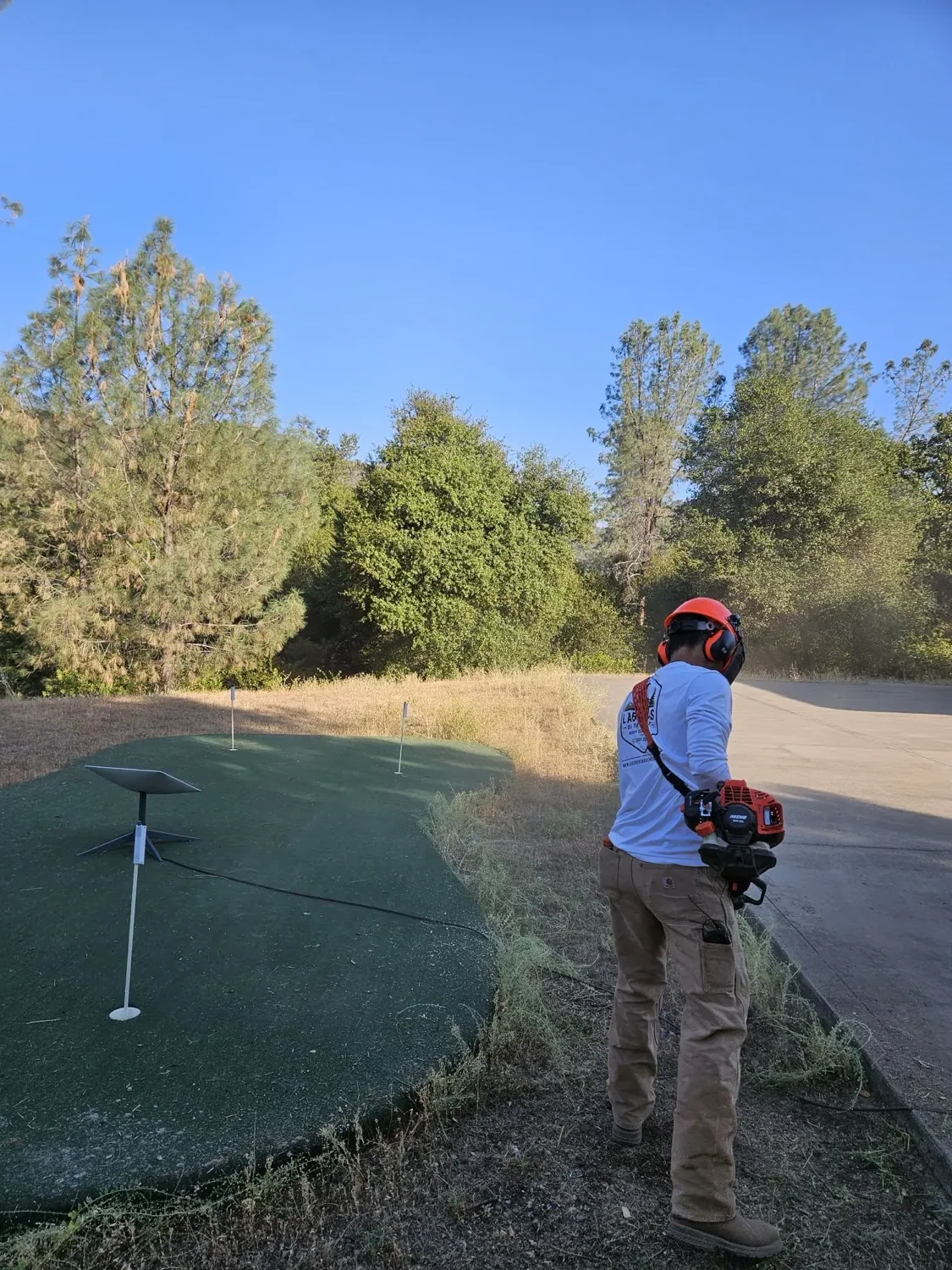
Match the method to the ground. Machines win on large, open, gently sloped acreage with heavy woody growth: a masticator averaged 0.57 acres per hour in federal production studies. Hand crews win on steep, rocky, or tight ground, around structures, septic systems, oaks and creeks, and anywhere specific trees must survive. Most Shasta County properties are the second kind of ground.
We are a hand crew, so read this knowing where we stand. But the comparison below is built from federal forestry sources, and it cuts both ways honestly. If your job is the first kind of ground, we will say so and you should hire a machine outfit. If it is the second kind, this is why brush clearing on foot is the professional method and not the budget one.
Where does each method actually win?
| Situation | Better fit | Why |
|---|---|---|
| Large open acreage, heavy woody growth | Machine | Mastication averaged 0.57 acres/hour in USFS-documented production |
| Stems over 4–6 inches, stumps ground out | Machine | Mulcher heads process 6–8 inch stems; hand crews cut, they do not grind stumps |
| Slopes past 30–40 percent | Hand crew | USFS operating limits: about 30% for wheeled, 40% for tracked equipment |
| Rocky or broken ground | Hand crew | USFS mulcher guidance: rock wears teeth fast and can spark; uneven ground hurts head control |
| Narrow strips and tight lots | Hand crew | USFS advises avoiding mulcher work in areas narrower than 66 feet |
| Keeping chosen trees in a dense stand | Hand crew | Guidance flags mulcher damage in stands denser than about 100 trees per acre |
| Around structures, glass, utilities | Hand crew | Selective cutting up to pavement and walls, nothing swung by a boom |
| Septic fields and drainlines | Hand crew | Heavy equipment can compact soil and crush tanks and pipes |
| Under oak canopies | Hand crew | Oak roots run shallow and past the dripline; compaction and root cuts injure the tree |
| Near creeks and seasonal channels | Hand crew | Federal practice keeps equipment 100 feet from waterways; bed and bank work triggers state notification |
| Low stem counts, light thinning | Hand crew | Mastication ran 2.5–3x the cost of hand thinning in the same stands (USFS research) |
Why do fire agencies run hand crews at all?
Because the ground demands it. CAL FIRE fields about 210 hand crews, and their stated function is building line where heavy machinery cannot be used: steep topography, rocky terrain, environmentally sensitive ground. Fuels-management research says the same thing in research language: crews deploy near structures, sensitive sites, and terrain machines cannot reach. CAL FIRE also runs mechanical fuels crews, because on the right ground machines are the right tool. The agencies use both. So does the market.
That is the frame for hiring, too. The question is never which method is better in general. It is which method your specific ground allows, and around Redding the answer is written in the slopes and the oaks.
What do Shasta County properties look like against those limits?
Run the table against local ground. The westside foothills and canyon lots pass 30 percent slope routinely. Decomposed granite and rock outcrop are the local norm, which is the exact tooth-wear and spark condition federal guidance warns mulcher operators about. Blue oak woodland covers the county’s most-cleared properties, and oak root zones are shallow, wide and compaction-sensitive. Seasonal draws that sit bone-dry in August still count as channels for state purposes.
None of that ground is exotic to a crew on foot. It is Tuesday. It is also why defensible space work here, which happens tight against structures on exactly this terrain, is hand work by nature. So is land clearing on lots and acreage where the ground is steep, rocky or full of keeper oaks.
What about cost?
Honestly split. Per-acre, machines beat crews on big heavy ground: published mulching rates run near $400 to $1,500 per acre while hand clearing publishes at $2,000 to $5,000. Three things pull the other way on real jobs:
- Low stem counts flip the math. Federal research measured mastication at 2.5 to 3 times the cost of hand thinning in the same open stands.
- Mobilization. Machines arrive on trailers, and contractors commonly report mobilization fees and $1,500 to $3,000 job minimums. A crew arrives in a pickup.
- Damage is a cost. A crushed septic line, a torn-up lawn, or a wounded oak is not on the quote, but you pay for it.
The full per-acre picture with sources is in brush clearing cost per acre.
When should you hire a machine outfit instead of us?
When your job is 15 open, gently sloped acres of heavy woody growth that all needs to go, no trees worth saving, no structures in play. That is mulcher work, it will be done in days, and per acre it will beat any crew’s number. We will tell you that on the phone and save everyone the walk-through.
Bring us the other jobs: the hillside behind the house, the fence lines, the oak understory, the lot between buildings, the ground by the creek, and the property where you can point at what stays. That is what a standing management schedule keeps handled year after year.
Call or text (530) 238-5077 for a free written estimate anywhere within 50 miles of Redding.