
How do you get rid of poison oak plants in California?
Pull or grub the whole plant, roots included, while the soil is moist. Or cut it to the ground and keep cutting the regrowth. Poison oak suckers from underground stems, so one pass never finishes it. Never burn it and never mow it. Wear gear the oil cannot soak through.
We are a veteran-owned hand crew based in Redding, so this comes from the cutting side of the work. The plant science below is UC IPM and Oregon State University Extension. What our crew does on a property is on our poison oak and blackberry removal page.
How do you spot western poison oak on your property?
Look for leaves of three, with the middle leaflet on a longer stalk than the other two. UC IPM describes a dense, leafy shrub usually 1 to 6 feet high in open sun. In shade it climbs as a vine up to 75 feet or more. The stems carry no thorns.
Each leaflet runs 1 to 4 inches long with toothed or lobed edges. New spring leaves come in green or sometimes light red. In fall they turn red and, per UC IPM, become enriched with urushiol. Then they drop, and UC IPM says the bare plant makes identification extremely difficult in winter. Damaged winter stems still release oil.
California blackberry is the local lookalike, since it also has three leaflets. UC IPM notes that poison oak lacks thorns along the stems and produces whitish fruits.
Why do the usual shortcuts make poison oak worse?
Most of them leave the roots and move the oil around. UC IPM says cultivating an area only once can fragment the rhizomes and spread the plant. Grubbing dry hard soil breaks off the stems and leaves rootstocks to resprout vigorously. Burning is worse again.
Mowing. UC IPM says mowing is not effective against poison oak and can put oil particles in the air. OSU Extension adds that the plant will readily resprout if mowed or cut.
Digging in dry ground. OSU Extension says to avoid grubbing in dry or rocky soil, because the roots break easily and resprout from fragments. That rules out most of a Redding summer.
Burning. UC IPM says to avoid burning poison oak, since it creates a serious health hazard and does not effectively reduce infestations. The oils disperse via the smoke particles, and breathing that smoke can cause severe respiratory irritation. OSU Extension points at wildland firefighters, who get rashes because burning plants release billions of urushiol particles into the smoke. CAL FIRE permits here have been suspended since June 15, 2026, per our guide to Shasta County burn permits.
Machines. UC IPM says a tractor with a brush rake or bucket often leaves pieces of root that readily resprout. Large equipment also creates a perfect environment for new seedling establishment. You buy a cleared look and a bigger patch. The wider comparison is in hand crew versus machine brush clearing.
Which removal method fits your ground?
Match the method to the size of the patch, the moisture in the soil, and who is doing the work. A small patch in soft ground can come out whole, roots and all. A large patch on a slope gets cut to the ground, then cut again on a schedule.
| Method | When it works | Limits | Who does it |
|---|---|---|---|
| Pulling or grubbing the whole root | Small patches, moist soil, early spring or late fall (UC IPM) | Dry or rocky soil breaks roots; fragments resprout (OSU) | You in full gear, or our crew |
| Repeated cutting to ground level | Large patches, slopes, oak understory, fence lines | Poor control unless repeated through the season (UC IPM) | Our hand crew |
| Grazing by goats or sheep | Small areas (UC IPM) | The plants come back (OSU); needs fencing and animals on site | A grazing service |
| Herbicide: triclopyr, glyphosate, imazapyr | The chemical option UC IPM lists | Glyphosate and imazapyr damage other vegetation (UC IPM) | Owner or licensed applicator. We do not spray |
| Tractor with brush rake or bucket | Strips top growth on open ground | Leaves roots that resprout and seeds new seedlings (UC IPM) | A machine outfit |
Poison oak near a house is fuel like any other brush. PRC 4291 tells owners in the State Responsibility Area to maintain defensible space of 100 feet from each side and from the front and rear of the structure. Grasses, weeds and wildland vegetation all count as fuel. Start with defensible space clearing to the 100-foot standard.
What do you wear, and where does the cut material go?
Cover the skin, then handle every tool and glove as contaminated. UC IPM recommends washable cotton gloves over plastic gloves. It warns that urushiol can persist on objects for months or even years, and still cause an allergic response. The cut material stays hazardous too.
| Step | What to do | Source |
|---|---|---|
| Cover up | Long sleeves, long pants tucked into boots, impermeable gloves | FDA |
| Gloves | Vinyl, which urushiol cannot penetrate | OSU |
| Skin | Wash in soap and cool water as soon as possible | FDA |
| Clothes | Clean exposed clothing with soap and water in a laundry machine | OSU |
| Tools | Wash equipment, tools and all clothing, including shoes | UC IPM |
| Cut material | Bury it, stack it out of the way, or take it to a disposal site | UC IPM |
Detached and dried brush can still cause dermatitis, so a pile by the driveway is a problem months later. On our jobs it gets raked out and staged, or loaded by the trailer-load for haul-off when the estimate says so.
The rash gets one paragraph here. FDA advises washing the skin in soap and cool water as soon as possible after contact. OSU Extension says it can erupt within 24 to 48 hours and last two to three weeks. FDA says to see a doctor for a temperature over 100 degrees Fahrenheit, pus or soft yellow scabs, or difficulty breathing.
Do vinegar, bleach or dish soap kill poison oak?
None of the three is listed as a control. UC IPM’s poison oak management section covers hand pulling or grubbing, grazing by sheep and goats in small areas, and post-emergent herbicides with triclopyr, glyphosate or imazapyr. Vinegar, bleach and salt appear nowhere in it, or in OSU Extension’s removal guidance.
The part that decides the outcome sits underground. UC IPM says established plants can sucker from rhizomes and spread in the adjacent area. OSU Extension says broken roots resprout from fragments. UC IPM’s herbicide sections are built around moving the chemical into the plant rather than wetting a leaf.
Dish soap has a real place in this work, on your skin. UC IPM calls forceful unidirectional washing with a damp washcloth and liquid dishwashing soap the best way to get urushiol off. OSU Extension lists Dial Ultra among cleansers shown effective in lab tests.
The word “permanently” is the one to drop. Poison oak is native here. UC IPM says seeds have a hard seed coat and can remain viable in the soil for many years. Removal plus follow-up is what happens on rural acreage.
When is the best time to pull or cut poison oak around Redding?
Pull it when the ground is wet, which here means late fall through early spring. UC IPM says to remove plants in early spring or late fall when the soil is moist. That is when rootstocks are easier to dislodge. Cutting works any time the crew can see what it is cutting.
The rain decides the pulling window. Redding averages 33.52 inches a year in the NOAA normals, and December through March carry 67% of it. By June the ground is hard and a pull turns into a snap. The rest of the calendar is in the best time to clear brush in Northern California.
Each end of that window has a catch. Fall leaves carry more urushiol, so October work calls for better gear. In winter the soil is softest but the plant is leafless. Mark your patches while the leaves are on.
UC IPM says brush removal in late summer, when plants experience moisture stress, can slow their ability to recover. A cut in the cure season and a pull after the rains pair well.
When should you hire a crew instead?
Hire when the patch is bigger than a weekend, when the ground is steep, or when poison oak is laced into blackberry along a fence. UC IPM says hand pulling is not recommended for individuals who are sensitive to this plant, and it puts roughly 50% to 75% of adults in that group.
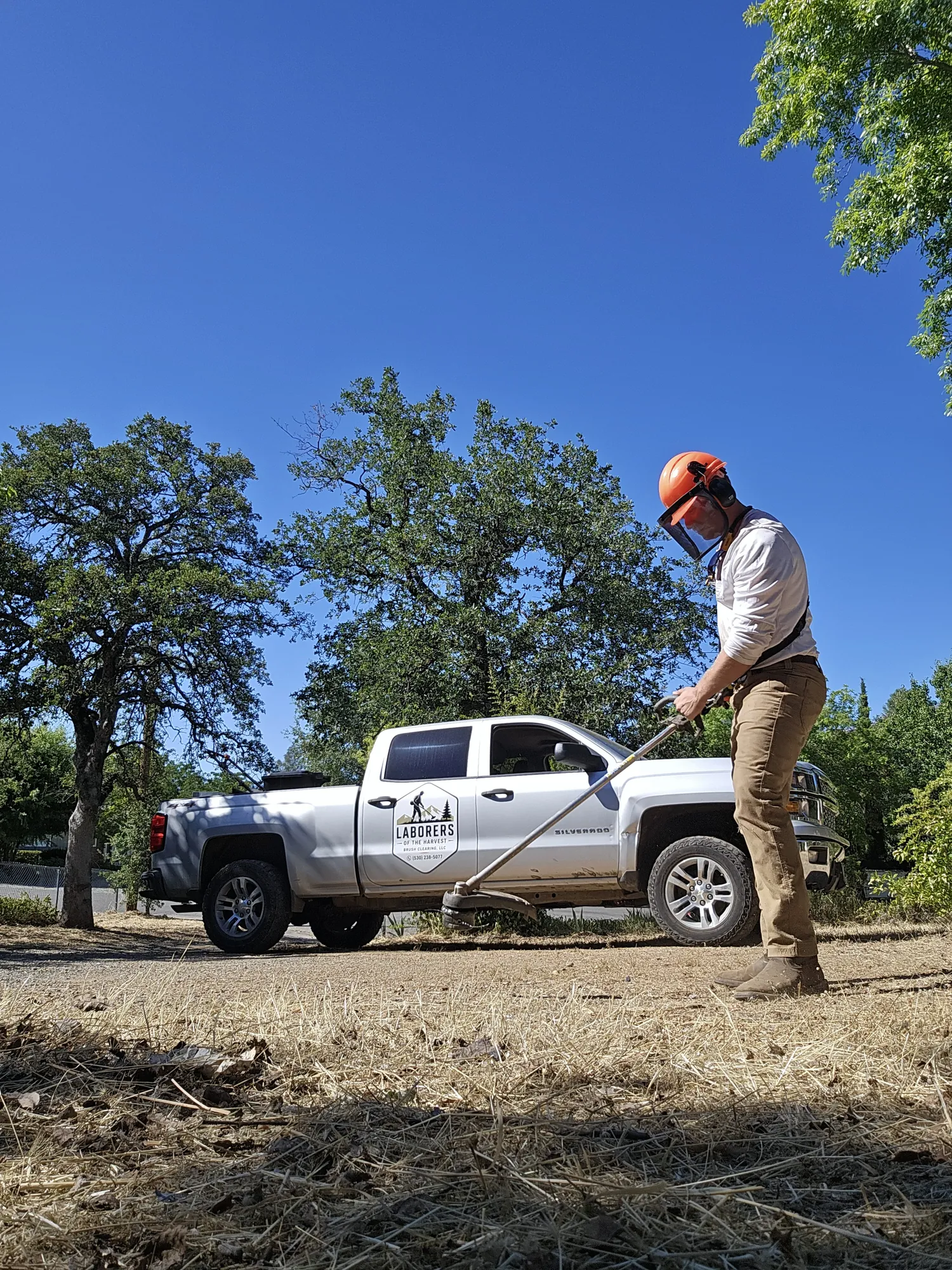
Our crew works it in full protective gear. Stems get cut to ground level with brush cutters, and blade heads go through hefty brush about two fingers thick. We detail around the oaks, fence posts and structures you want left alone.
Fence lines are the usual call. UC IPM says blackberry cane tips that contact the ground often form roots, so a wall of thorns walks the wire while poison oak climbs through it. For the thorny half, our guide on how to get rid of blackberry bushes compares cutting, digging and goats. That job is clearing an overgrown fence line on a ranch.
Neither plant dies from one cut, and we say so at the estimate. The first clearing opens the ground, then a cut schedule holds the regrowth down. How we cut poison oak and blackberry by hand lays out the service.
We work around Redding and out through the oak country in Palo Cedro, Cottonwood, Bella Vista and Millville and the acreage around it. The company carries $1 million in general liability.
Call or text (530) 238-5077 for a free walk-through and a written estimate, anywhere within 50 miles of Redding. We can usually get eyes on the ground within days, and the estimate documents the acreage and linear footage before anyone cuts.