
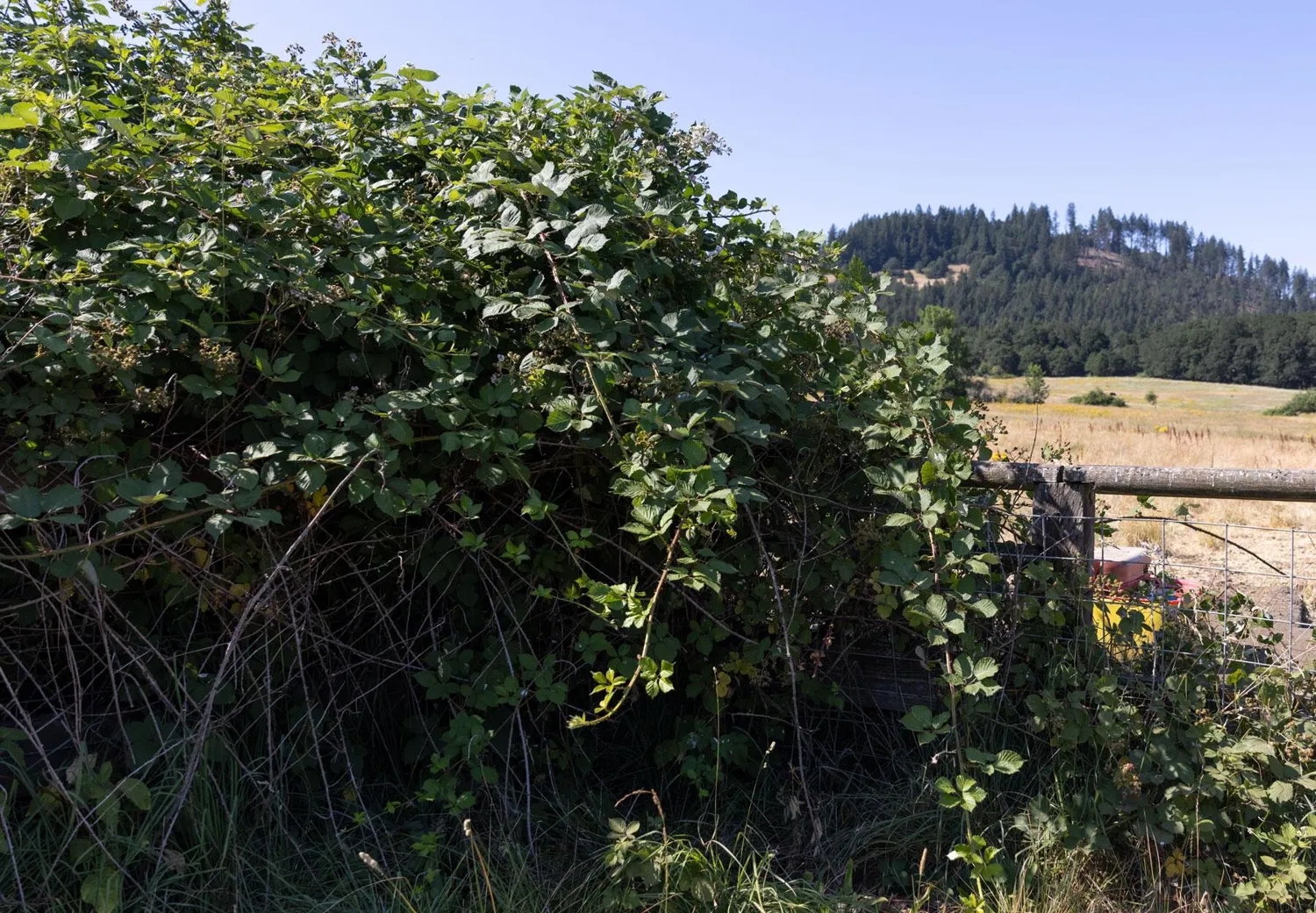
How do you get rid of blackberry bushes in California?
Cut the canes to the ground. Then dig out the crown while the soil is moist, in early spring or late fall. A crown left in the ground sends up new canes, so plan on repeat cuts or grazing for the regrowth. Plan on more than one season, too.
We are a veteran-owned hand crew based in Redding, and cutting blackberry is part of our work. The plant science below comes from UC IPM, Cal-IPC and Oregon State University Extension. How our crew handles it on a property is on our poison oak and blackberry removal page.
Why do blackberry bushes keep coming back?
The crown underground is the part that matters. UC IPM says individual canes only live for 2 years, but blackberry plants can live for 25 years or longer. New canes come up from the root crown every year to replace the ones that die.
A patch also spreads on its own. Cane tips that touch the ground often form roots and start daughter plants. New plants sucker up from rhizomes, which are underground stems. OSU Extension says birds and animals eat the berries and spread the seeds over long distances.
It adds up quickly. OSU Extension says a single plant can grow into a six-square-yard thicket in less than two years. UC IPM says that over time, a single plant can cover a very large area.
Cal-IPC rates Himalayan blackberry (Rubus armeniacus) High, its rating for species with severe ecological impacts. It lists the plant in the coast ranges, the Central Valley and the Sierra Nevada. The thickets grow so dense that the lack of light severely limits the plants underneath.
Himalayan blackberry is the one to look for. UC IPM says it stands out for its stout thorns and 5 distinct leaflets, on evergreen stems with 5 angles. The native California blackberry has only 3 leaflets, which is why it gets mixed up with poison oak. Our guide to getting rid of poison oak covers that plant.
UC IPM tells owners to focus on controlling a wild blackberry population to a desired level. That is how Himalayan blackberry control works on rural acreage: open the ground, then hold it.
Which blackberry bush removal methods reach the crown?
Judge every method by what it does to the crown, since new canes come from there. UC IPM says blackberries can regenerate from the crown or rhizomes after mowing, hand pulling, tillage, burning or herbicide. So every row below needs a follow-up plan.
| Method | What it does to the crown | Follow-up needed | Where it fits |
|---|---|---|---|
| Cut canes, then dig or pull the crown | Removes it, when moist soil lets the roots come out (UC IPM) | Pull resprouts and seedlings; one dig can fragment rhizomes (UC IPM) | Small patches and young plants, early spring or late fall |
| Repeated cutting through the season | Leaves it, but each cut strips the leaves that feed the roots (OSU) | Poor control unless repeated through the growing season (UC IPM) | Large patches, fence lines and banks, with care in fire season (UC IPM) |
| Goats and sheep | Leaves it; they eat the resprouts (UC IPM) | Grazing pressure high enough to keep suppressing growth (UC IPM) | Small areas; goats mostly graze the edges (OSU) |
| Herbicide with triclopyr or glyphosate | Can still regrow from the crown afterward (UC IPM) | One application does not always control it; watch for at least a year (UC IPM) | The owner or a licensed applicator, away from water and keeper plants |
| Burning | By itself not effective; can increase the population (UC IPM) | A control plan afterward, or the patch can come back worse (UC IPM) | Off the table: CAL FIRE permits are suspended in the county’s State Responsibility Area |
Cutting canes, then digging the crown. UC IPM says small infestations can be removed by hand-pulling or grubbing, with shovels, picks, chains or specialized tools. It calls hand-pulling young plants in moist soil the most effective way to remove blackberries. OSU Extension calls physical removal the most effective long-term strategy.
The limits are real. UC IPM says it is extremely difficult to hand-pull large plants. Pulling in dry, hard soil usually breaks off the stems and leaves roots that will vigorously resprout. Digging out roots only once can fragment the rhizomes and spread the weed.
OSU Extension adds that digging creates an ideal seedbed for new seedlings. Its fix is replanting with hardy perennials, such as grasses, to crowd out the new shoots.
Repeated cutting through the season. Cutting canes to the ground opens the patch in one pass, and the crown answers with new canes. UC IPM says a lawn mower gives poor control unless it runs repeatedly throughout the growing season. Loppers near the base work the same way, and lopping can lead to vigorous resprouting.
Repetition is what makes cutting work. OSU Extension says mowing and goat grazing both weaken the plant by repeatedly removing leaves, which starves the roots. UC IPM adds that mowing or chopping gives short-term canopy reduction that helps desirable grasses and broadleaf plants grow.
Our crew cuts canes to ground level with brush cutters. The blade heads go through hefty brush about two fingers thick. The regrowth then goes on a schedule of repeat cuts, set with you at the estimate.
Goats and sheep. Grazing works best on regrowth. UC IPM says goats and sheep have been shown to feed vigorously on resprouting shrubs, including blackberries. It also says grazing can control small areas if the pressure is high enough to continually suppress growth.
OSU Extension says goats tend to graze only around the edges of a patch. People sometimes mow paths, lay boards or flatten canes so goats can reach the center. It also notes that grazing and mowing both require repeated effort and can damage surrounding vegetation. Put together, goats fit best as a follow-up on a small area after the first cut.
Herbicide. This is UC IPM’s chemical option, for the owner or a licensed applicator to use. UC IPM lists herbicides with triclopyr and glyphosate for California residents. Glyphosate is nonselective, so it damages or kills other plants, and triclopyr spares grasses but not other broadleaf plants.
Water changes the picture. UC IPM says several of these formulations are not registered for use near water. Its advice is to avoid herbicides in and around water to protect water quality. When blackberry lines a pond, clearing it by hand falls under our pond edge and shoreline weed abatement work.
Even away from water, UC IPM says a single application does not always completely control blackberries. Our crew works by hand, so our part is cutting and pulling.
Burning. UC IPM says that by itself, burning is not an effective method for controlling blackberries. In many cases it can increase the population, because it removes competing plants and wakes up seeds in the soil.
Without a control plan after a burn, UC IPM warns the patch may come back worse than before. CAL FIRE has residential burn permits suspended in the Shasta County State Responsibility Area. Our guide to Shasta County burn permits tracks the status. What our crew cuts gets staged or hauled.
When is the best time to dig out blackberry crowns?
Dig when the ground is wet. UC IPM says plants come out easiest in early spring or late fall, when the soil is moist. Around Redding, that means after the fall rains soften the ground, or in spring before it dries out.
Cutting follows a different calendar. UC IPM says a late-summer cut, when plants are under moisture stress, can in some cases slow their recovery. The same guide carries a fire warning. In fire-prone areas, it says to use extreme caution when mowing during spring and summer, because mowers can spark wildfires.
A blackberry patch ringed by cured grass in summer is that setting. Crown work waits for moist soil either way. Our clearing calendar for Northern California lays out the rest of the year.
Seed is the other clock. UC IPM says second-year canes flower, fruit and die, and that mowing later in the growing season can spread seeds. OSU Extension says canes can produce hundreds of berries, each full of seeds.
Where do the cut canes go?
Plan the disposal before the first cut. The Shasta County Fire Safe Council offers a free chipping program. Blackberries are on its list of materials it cannot chip, along with poison oak, scotch broom and vines. Roots are too, so dug crowns cannot go in a chipping pile either.
That leaves a green-waste load or a hauled load for the thorny canes. On our jobs, cut material gets raked out and staged in clean piles. When the estimate scopes haul-off, it gets loaded by the trailer-load and taken away.
When should you hire a crew instead of doing it yourself?
Hire out when the plants are too big to pull. The same goes for a patch on a fence line or a bank. UC IPM says the tangled mass of thorny stems blocks access to pastures and waterways, for livestock and people alike.
The thicket is also a hazard. UC IPM says vigorous growth and a buildup of dead stems can create a dangerous fire hazard. Near a house, a thicket can give rats food and shelter.
A blackberry-choked fence line is its own job, and it is fence line and roadside clearing. When blackberry is one piece of a wider overgrown property, the job is brush clearing.
On any of these jobs, our crew details around fence posts, keeper trees and structures you want left alone. Crowns get pulled when the soil is moist, and the regrowth goes on scheduled cuts. Every job gets before-and-after photos. The second half of the payment is due when the work is done to your satisfaction.
Price depends on the patch size and whether the crowns come out or stay on a cut schedule. The written estimate documents the acreage and linear footage, so you can hold the finished work against it.
We are a veteran-owned company, insured with $1 million in general liability. We work across Shasta County and Tehama County, from Anderson and Cottonwood to Red Bluff and Corning. Call or text (530) 238-5077 for a free walk-through and written estimate anywhere within about 50 miles of Redding. We can usually get eyes on the ground within days.