
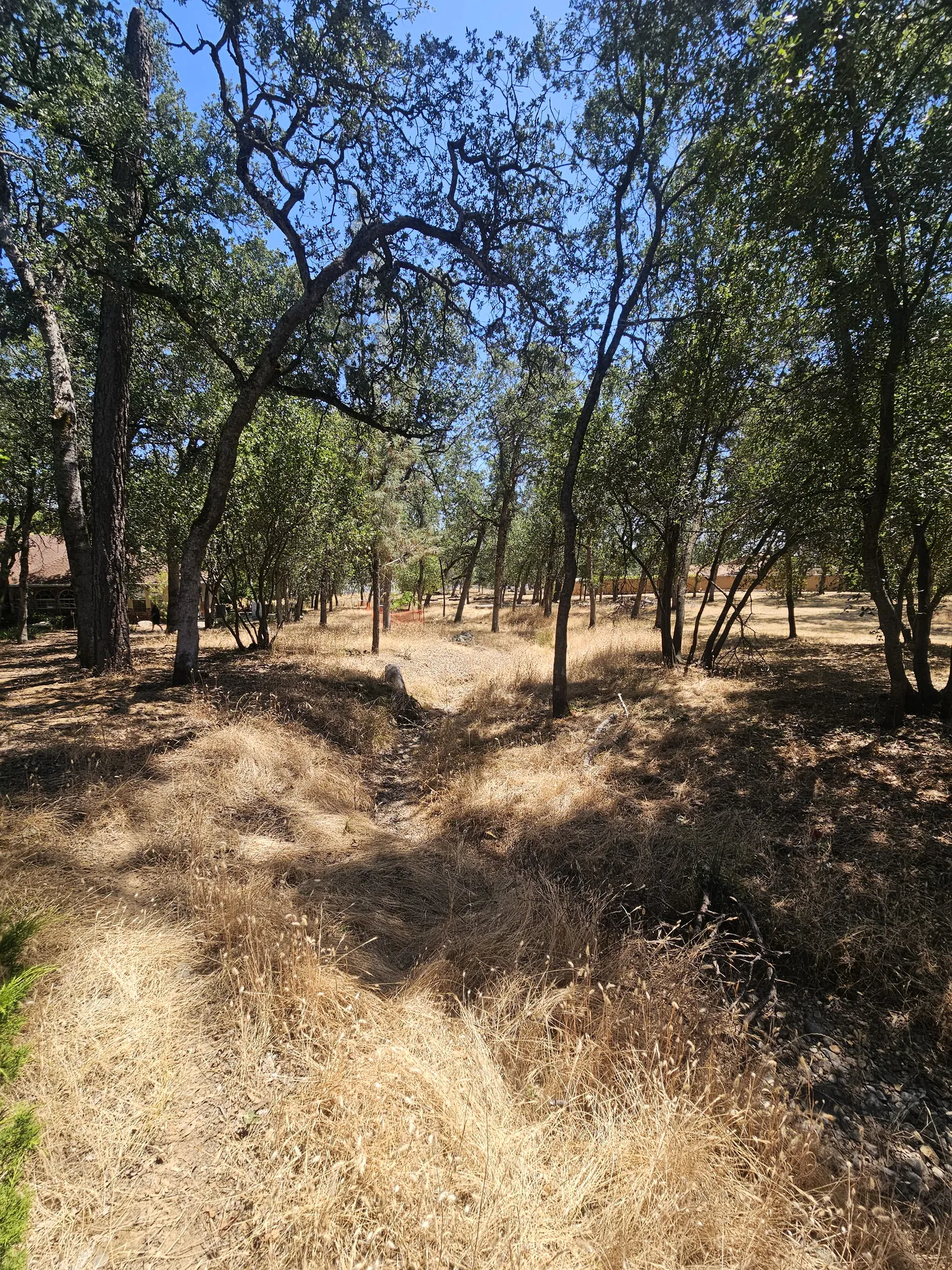
What are California’s defensible space requirements?
California requires 100 feet of defensible space around structures in fire-prone areas, or out to your property line, whichever comes first. That comes from Public Resources Code 4291. The 100 feet splits into zones with different standards: heavy cleanup in the first 30 feet, spacing and fuel reduction from 30 to 100. A new Zone 0 standard for the first 5 feet was approved on August 19, 2026 and is in final administrative review.
Around Redding, that state law is only half the story. Shasta County adopted its own defensible space ordinance in 2025, and it reaches further than most owners realize. Here is the whole picture, zone by zone, with what an inspector actually checks. When you want the work done instead of described, our defensible space crew handles it to these standards.
What does each zone require?
| Zone | Distance | What is required |
|---|---|---|
| Zone 0 (approved, pending final review) | 0–5 ft | Ember-resistant zone: no combustible mulch, firewood, or dead material; strict plant limits; non-combustible strip at the wall. Approved August 19, 2026 |
| Zone 1 | 0–30 ft | Remove all dead or dying grass, plants, shrubs, branches, leaves and needles, including on the roof and in gutters. Branches kept 10 ft from chimneys. Firewood moved out or enclosed |
| Zone 2 | 30–100 ft | Reduced fuel zone: annual grass cut to 4 inches or less, surface litter no deeper than 3 inches, dead wood removed, and spacing between trees and shrubs that grows with slope |
The Zone 2 spacing rules are where most properties fail. On flat ground, tree canopies need 10 feet between them and shrubs need spacing of twice their height. On steep slopes those numbers grow to 30 feet and six times shrub height. Ladder fuels matter too: the vertical gap between a shrub and the tree branches above it must be three times the shrub’s height.
Is Zone 0 law yet?
Nearly. The Legislature ordered an ember-resistant zone back in 2020, and on August 19, 2026 the Board of Forestry approved the final regulation unanimously. It still has to clear the Office of Administrative Law, with a short public comment period, before publication makes it official; officials estimated early September 2026 for that review. Once effective, new construction complies first and existing homes get a phased runway of roughly 3 to 5 years. The full breakdown of what the rule bans and allows is in our Zone 0 guide.
What the draft requires in the first 5 feet: no combustible mulch or wood chips, no firewood, no dead or dying plants, nothing stored that burns, a non-combustible strip against the structure, vegetation kept away from windows, vents and attached decks, and no new trees planted in the zone. If you keep the first 5 feet clean now, the adoption date will not matter to you.
Who has to comply, and who inspects?
It depends on where your parcel sits. Unincorporated Shasta County is largely State Responsibility Area, where PRC 4291 applies and CAL FIRE’s Shasta-Trinity Unit inspects on a roughly three-year rotation. Redding city limits are Local Responsibility Area, where the same duties apply in the city’s mapped very-high hazard zones under Government Code 51182, enforced by Redding Fire. Either way, the standard reads the same on the ground.
The state’s goal is about 250,000 inspections a year, and its own damage data explains the push: structures without compliant defensible space are six times more likely to be destroyed in a wildfire. Around here nobody needs the statistic explained. The 2018 Carr Fire burned 229,651 acres, took eight lives, and destroyed about 1,600 buildings.
What does Shasta County’s own ordinance add?
In September 2025 the county adopted Ordinance 2025-03, now Chapter 8.10 of the county code, and it applies across unincorporated Shasta County whether or not a structure is on the parcel. The parts that surprise owners:
- Parcels of 2 acres or less must treat the entire parcel, instead of the usual 100 feet around a building.
- Parcels between 2 and 10 acres need a 30-foot cleared perimeter or a plan approved by the Fire Warden.
- Adjacent parcels under the same ownership count as one parcel for compliance.
- Weeds and annual grasses must be kept to 4 inches or less, stumps cut to 8 inches or less.
- Violations are chargeable as infractions or misdemeanors, and abatement costs can be assessed against the parcel as a lien.
That whole-parcel rule is the big one. A vacant 1.5-acre lot in the county now carries the same duty as a lot with a house on it. If you hold land you do not live on, our guide to weed abatement notices in Redding covers how enforcement actually plays out, city and county.
What does an inspector look at first?
The first 30 feet. Dead vegetation anywhere in Zone 1, including the roof and gutters, is the fastest fail. After that: grass height, ladder fuels under trees, branches near chimneys, and combustibles stacked against the house. The fix list is physical work, most of it on ground a machine cannot reach without tearing up the property. That is the work our hand crew does all season, and wildfire fuel reduction beyond the 100-foot line is the same job at larger scale.
Fines for PRC 4291 violations start at $100 to $500 as an infraction and escalate on repeats, with the state able to clear the ground and bill you on a third offense. Local enforcement leads with education and a recheck, which means the window between a failed inspection and real consequences is your cheapest time to act.
Get the ground compliant before the recheck
We build defensible space to these standards on any terrain a boot can reach: Zone 1 detail work, Zone 2 spacing, whole-parcel county compliance. Written scope, dated before-and-after photos you can show an inspector, $1M in liability coverage. What it costs is covered honestly in what defensible space clearing costs in Northern California.
Call or text (530) 238-5077 for a free written estimate anywhere within 50 miles of Redding.