
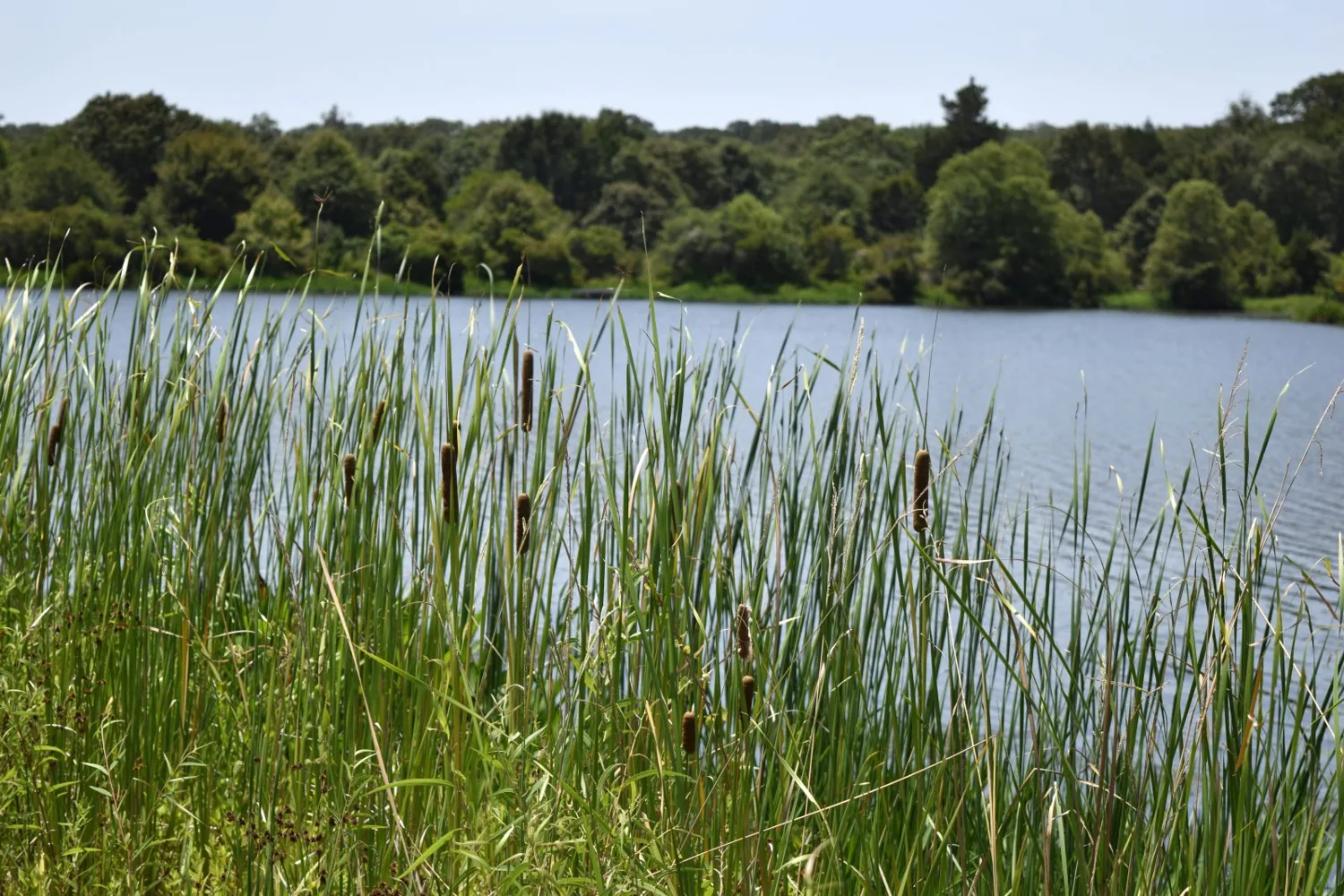
How do you get rid of cattails and pond weeds without chemicals?
Cut them below the waterline, 2 to 3 times in a growing season, and haul the cuttings out. Federal researchers recorded cattail stands dying outright when stems were cut under water and the stubble stayed flooded; three below-water cuts in one season produced almost complete root death. No spray, no harm to fish, and late summer, right now, is the most damaging time to cut.
That is the short version of the technique we use on pond edge and shoreline clearing jobs around Redding. The long version below covers why edges overgrow so fast here, the timing that makes cutting actually work, and the reasons chemical shortcuts are less simple than they look in California.
Why does a pond edge overgrow so fast?
Because the plants that take it over are built for exactly that. A common cattail spike carries on the order of 222,000 seeds, and federal plant research documents a single seedling building a rhizome patch 10 feet across in one growing season. Cattails establish in water up to about 18 inches deep or in wet bank mud, then spread laterally through the shallows by underground rhizome.
Tules, the native hardstem bulrush of California marshes, play the same game: densely rhizomatous, 5 to 10 feet tall, able to stand in deeper water and crowd out neighbors. Add willow seedlings, which colonize exposed pond banks quickly from airborne seed, and Himalayan blackberry walking down the upper bank by rooting its cane tips, and a neglected shoreline can close itself off in a couple of seasons. Small stock ponds in the oak country around Redding, already warm and shallow at the margins, are ideal territory.
Some fringe is good. Fish and wildlife agencies put the healthy range at roughly 10 to 20 percent of the pond surface in plants. Inside a dense stand, though, measured light drops below 2 percent of ambient and dissolved oxygen falls, and a full takeover costs you the water view, the bank access, and eventually the fishing.
Does cutting actually kill cattails?
Yes, when it’s done on the plant’s schedule instead of yours. Cattails live off carbohydrates stored in their rhizomes. Every cut forces the plant to spend reserves regrowing; cutting below the water surface adds suffocation, because the flooded stubble can’t move air to the roots. The published results are blunt: cut-and-flooded stands died, and 2 to 3 below-waterline cuts in a season left very few plants returning the next year.
Two honest caveats. First, one casual cut is cosmetic; the stand regrows from stored food, which is why drive-by mowing disappoints pond owners every year. Second, whatever gets cut must leave the water. Cuttings left floating rot, feed the next generation of weeds, and drag oxygen down. Bag it, haul it, done, the same discipline as any lot cleanup.
When should shoreline work happen?
| Timing | What to do | Why |
|---|---|---|
| Spring (May) | Don’t make your only cut now | A single spring cut stimulates cattail growth |
| Summer | First and second cuts, at or below the waterline | Forces the plant to burn root reserves regrowing |
| Late August to September | The most valuable cut of the year | Plants are moving food to the rhizomes; cutting now hits hardest |
| Fall | Clear dry stands near structures; haul all material | Dried cattails and tules are serious fire fuel |
| Winter | Skip it, or cosmetic only | Cutting barely affects root reserves |
| Every year | A maintenance pass on the fringe | Any surviving rhizome regrows; agencies call the work recurring |
The late-summer window matters most, and it’s open now. It also happens to be when Shasta County pond levels sit lowest, which exposes more stem to cut below the eventual waterline.
Why not just spray them?
Because in California, water is where herbicide rules get serious. Applying aquatic herbicide to surface waters requires coverage under the State Water Board’s statewide permit, with an application plan filed well in advance, and hiring it out requires an applicator licensed specifically for aquatic work. The common garden glyphosate bottle is not a workaround: standard landscape formulations carry a surfactant that federal fact sheets document as far more toxic to fish than the herbicide itself, and only aquatic-labeled formulations are legal on water.
None of that says chemicals can never make sense on a large infested lake. It says that for a farm pond fringe, cutting wins on simplicity: no permits, no water chemistry, no waiting period, nothing near your fish. Hand work also spares the bank itself. Machines rut and slump soft shorelines, and on embankment dams, engineering guidance is firm that woody vegetation doesn’t belong at all; tree roots open seepage paths through the fill. A crew on foot takes willow starts off a dam face without disturbing the structure.
The mosquito and fire angles
Two local reasons to keep the fringe honest. The Shasta Mosquito and Vector Control District’s own physical-control playbook includes steepening pond banks to discourage emergent vegetation and removing the brush and berry cover that shelters mosquito larvae; the district also gives free mosquitofish to residents for ponds and troughs. West Nile virus is not abstract here: the district announced its first positive samples of the 2026 season in Anderson in July, and state totals this year ran at a five-year high.
Fire is the other one. Dried cattail and tule stands burn hot enough that federal wildlife managers run prescribed burns specifically to clear that fuel, and a dry stand against a fence line or outbuilding is fuel like any other. Within 100 feet of structures, California’s defensible space law already requires dead vegetation gone, no exception for the wet corner of the property that dried out in July. Our clearing calendar covers how the fire season shapes all of this timing.
When does CDFW enter the picture?
California requires notifying the Department of Fish and Wildlife before work that substantially diverts or obstructs flow, changes the bed, bank, or channel, or deposits material into a river, stream, or lake, and that includes channels that run dry in summer. Hand-cutting vegetation above the waterline on a self-contained pond is a different animal from reshaping a bank. But many Shasta County ponds sit on seasonal drainages, where the rule genuinely reaches. The clean move when in doubt: one call to CDFW’s Northern Region office in Redding before bank work, the same ask-first logic as our land clearing permit guide.
We stay on the cutting side of that line: vegetation off the banks, edges, and dam faces, by hand, hauled away, with the fringe left where you want it. If your pond has been disappearing behind its own cattails, late summer is the right time to take it back.
Call or text (530) 238-5077. Free written estimates anywhere within 50 miles of Redding.